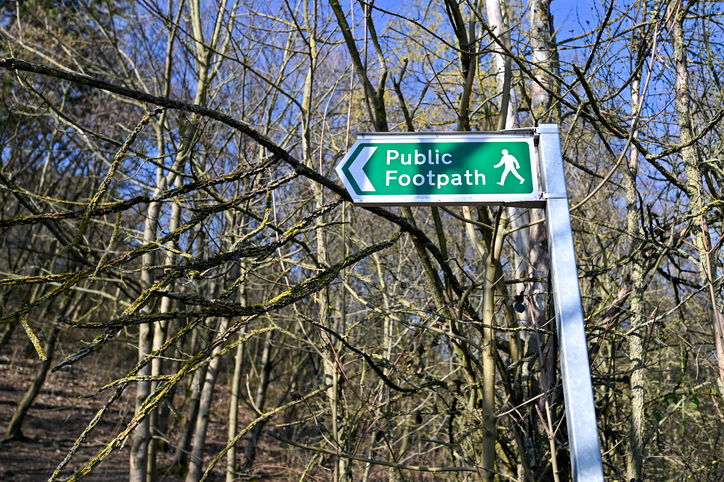
Lauren Walker, Partner in the Real Estate team, looks at the possibilities of diverting or stopping a public footpath.
It is common to have a public footpath running through the boundary of a property, particularly in rural areas. Some landowners may enjoy the open feel of public rights of way through their property, whilst others may want their land to be private and enclosed. If you are in a similar position and want to find out whether it is possible to strike off or divert a public footpath, please continue reading!
In such an instance, it is possible for occupiers to apply to their local authority to divert a public footpath. These rights are contained within section 119 of the Highways Act 1980, which empowers a local authority to divert a footpath where it crosses the interests of a landowner, lessee or occupier by granting the applicant with a “public path diversion order”. An order will only be granted, however, if there is agreement from the Secretary of State, or if the proposed order does not receive any objections.
The difficulties that can arise in applying for the diversion of a footpath have been demonstrated in the case of Bennett v Secretary of State for the Environment Food and Rural Affairs [2023] EWHC 2542 (KB). In this case, a public footpath ran through the claimant’s land. The claimant applied to divert the footpath and the local authority approved this application pursuant to their rights under section 119. Despite the local authority approving the application, a third party from the Open Space Society objected to the diversion of the path, causing difficulty to the claimant’s application.
Given the objection, the Secretary of State had to determine whether a public path diversion order should be granted. Section 119(2)(b) focuses on convenience to the public, and states that if an order is made to divert the footpath, the new footpath should be “substantially as convenient to the public”. Section 119(6) defines “substantially less convenient” by considering the following:
- The impact that the diversion would have on public enjoyment of the path;
- The effect that an order would have in respect other land served by the subject existing public right of way; and
- Any new public right of way that would be created by the order that affects the land over which the new right of way is created, along with any land held with it.
The Secretary of State proceeded to visit the footpath but failed to determine whether an order should be made. Consequently, the claimant made a claim for Judicial Review which is the process for questioning a decision made by a government institution.
The main issue to determine was therefore whether the diversion of a path following an application to the local authority results in a substantially less convenient situation to the public. Following the claim, point 16 in the judgement by The Honourable Mr Justice Jay found that the diverted path resulted in an additional 17 metres of trail which was not considered to cause significant impact to those that may use the footpath. Point 17 identified that the diverted path was dryer than the existing path and would have resulted in easier access arrangements to the public, increasing public convenience. However, point 19 identified that the footpath decreased in width due to overgrown vegetation resulting from a fallen tree. Point 23 focused on the issue of width and found that the diversion route provided better forms of access to the public, but the issue of width outweighed the benefit of easier access arrangements. It was therefore found that it was inappropriate for the Secretary of State to confirm the order. In this specific case, it is interesting to investigate S154 of the Highway Acts 1980, which essentially states that a local authority can put a landowner or occupier on a 14-day-notice to cut back vegetation to remove danger, obstruction or interference with a road or footpath.
Point 35 in the judgement of this case went on to set out a three-stage test that applies when trying to determine whether a public path diversion order should be granted. The three-stages are as follows:
- Is the diversion expedient in the interests of the landowner, lessee or occupier? This was defined as being a “low-test” in the case of R (Hargrave) v Stroud District Council [2001] EWHC Admin 1128.
- Is the diversion substantially less convenient to the public as per S119(6)?
It is important to note that the above steps must be met before the third step is discussed. If they are met, the third step below can be investigated.
- Would it be reasonable to grant the order, having regard to the diversion’s effect on the public’s enjoyment of the path, the effect of the order on other land served by the path and whether there are any new rights of way that are to be made if the order is granted?
In this particular case, points 1 and 3 were satisfied but point 2 was not. It was found that the Secretary of State’s decision to decline the order should be overturned. This case has now been remedied, and the diverted path has been repaired and excess vegetation has been trimmed back to make the path safe for the public.
Therefore, yes, it is possible to divert a public footpath. The first step is to apply to the Local Authority for approval. The decision here will then further the process and determine whether any objections are received or whether the Secretary of State grants or denies the application. It is also vital to remember the three-stage test as set out above, and whether these can be met or not. This will determine the likelihood of an application for a public path diversion order being granted and consider the needs of the applicant along with the safety and well-being of third parties and members of the public that may use or be affected by the diverted path.

This article is for information only and does not constitute legal advice. We recommend seeking professional advice before taking any action on the information provided. If you would like to discuss your specific circumstances, please feel free to contact us on 0118 951 6200.